Skip to content


Reminder, training with Sensei Ed – Saturday, June 1

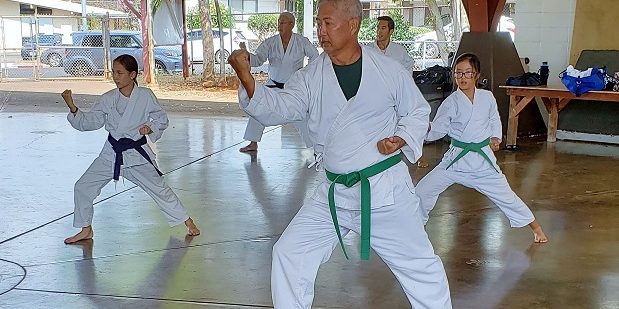
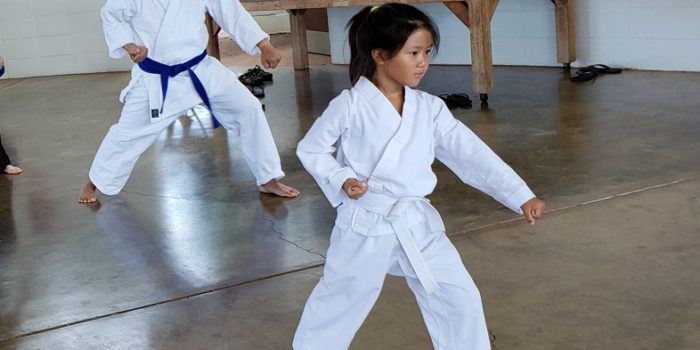
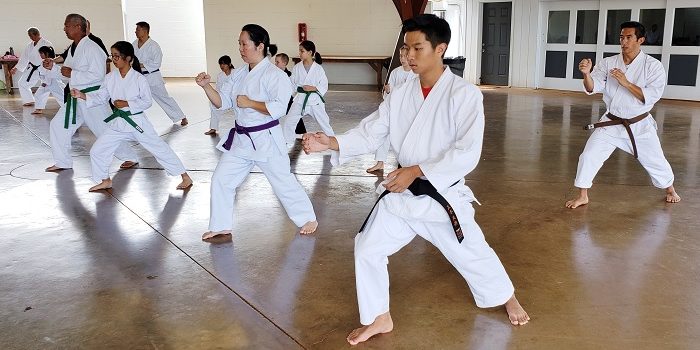
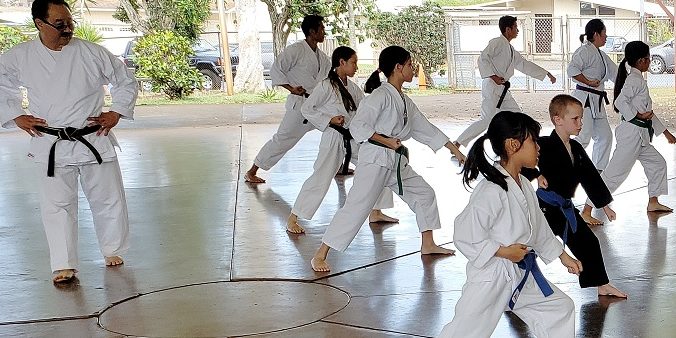
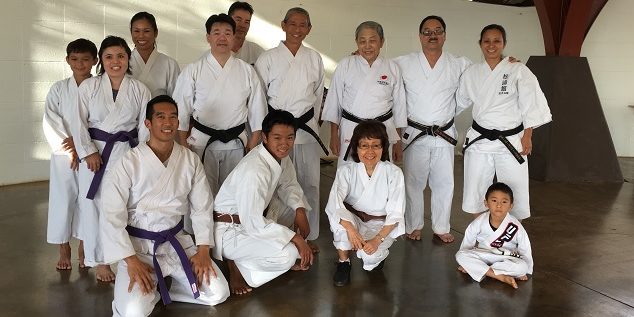
Just a quick reminder that we’re fortunate to have Sensei Ed Fujiwara visit us on Saturday, 1 June as guest instructor.  Sensei Ed was my teacher from the mid-eighties through the mid-nineties.  Sensei Trisha was also lucky enough to train under him during those years.  In turn, for four decades, Sensei Ed was a personal student of the late and legendary Master Tetsuhiko Asai, one of the most gifted karateka the world has ever known.  Whenever Sensei Ed shares some of his great karate knowledge, he is also sharing some of the unique insights that he gained during his long association with his mentor and friend, Master Asai.  Any of you who have spent time with him knows that a session with Sensei Ed, is never a “usual day at training”, haha.

On that Saturday, please come early – I always arrive well before our 09:00 am start time, but inevitably, find Sempai James, Sensei Ed, and Sensei Ed’s father, already dressed and warming up for class.

Blessings, Wes

Posted in announcements.

A New Year Tradition

As we welcome in the brand year of 2013, it is filled, both with a sense of anticipation on what the new year brings for us all, as well as a natural reflection on how we did in the old year, 2012.  Every new day, of course, is really kind of a repeat of past days – it is how we view and treat it, what we do with it, that makes all the difference.  In the case of the first day of the new year, we each realize that this is something special.

I suppose that I’m kind of lucky to be one of those who has a nearly continuous memory of major and mundane events in one’s life, going back to around 3-4 years old.  Oh, I don’t remember every little detail, but similar to recalling what happened last year, I have decent memories back to around 1955.  I have read somewhere that lying dormant in our brains, are organic bytes ready to relive every memory of every moment of our lives – the challenge is being able to locate the information.  Eidetic (or photographic) memory must be an amazing gift – but then, you’d also remember all of the junk stuff too, haha.  Anyways, the earliest New Year’s Eve I can remember was spent at my relatives’ home in Kalihi.  Their steep, brush-covered backyard was a part of the western slopes of Kalihi Valley (on the other side of their ”backyard hill” was Fort Shafter).  They had a terrific panoramic view of Honolulu city, from which we watched the old-time aerials and could hear the thunderous sounds of fireworks echoing through the smoke-filled valley.  I was introduced to the wonderful world of crackerballs, sparklers, checkerbombs, and the ancient roman candles.  Of course, at that age, I could only hold the sparkler and throw a few crackerballs…boy, I wonder how closely my parents kept watch over us back then ;)   My dad would drive us back home in the wee hours of the new year and I’d enter the first day of the year, fast asleep, my head bobbing on my dad’s muscular shoulder as he carried me into the house.

Over the next few New Year’s Eves, my annual challenge would be to stay up through midnight, hear the mighty roar of thousands of firecrackers, and welcome the new year with my cousins and the adult relatives (I have never understood the significance of singing “Auld Lang Syne” – better known as “We’re Here Because We’re Here, Because…” heheh).  I graduated from sparklers to crackerballs, then later to firecrackers.  As a teenager, I had the occasional honor of lighting the “20,000″ firecracker packs at midnight.  I use quotations because there was always a question as to whether those expensive packs really contained 20,000 firecrackers or not :)   I’d go to bed at about 3:00 am, sleep late and wake up to watch the recently created Superbowl football game with my dad.

The day after New Year’s Eve is the first day of the new year itself.  My parents began to host the family Eve celebrations when I was around 8 or 9 years old.  From then on, my very first act of the first day of the new year began by….sweeping the tons of red paper on the driveway, on the front lawn, and on the street.  The task would take no more than a half hour to complete (unless it had rained that night) and gradually began to take on a symbolic meaning to me.  I felt as if I were actually (and metaphorically) sweeping away the remnants and trash from the previous year.  After all of the debris had been collected up and stuffed into trash bags, I would complete the process by washing down the driveway.  The cleaned frontage kind of represented the brand new year – kind of a neat way to start off the day, and the year.
The last time we ever hosted and popped firecrackers at my parents’ home was some 35 years ago.  I outgrew my fascination with fireworks and popped my last firecracker way back then.  Today, we celebrate New Year’s Day by joining my wife’s family and sharing in eating mochi soup.  The tradition of popping firecrackers, while still carried out by some, has largely gone away.  I don’t miss the noise and I don’t miss the smoke…but sometimes, I do think about my own mini-tradition of sweeping out the old year and washing down to welcome the new.  I’m sure that each of us has our own thoughts on the turning of the new year…I pray that it’s as special a time for you as it is for me.  Have a terrific year in 2013!

Posted in life lessons.

Training in a Park

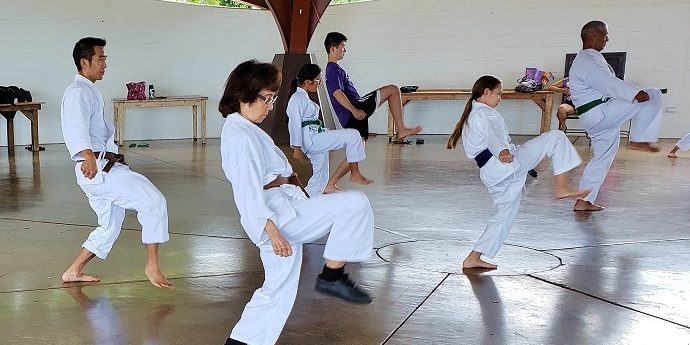
I sometimes compare the open pavilion where we conduct our karate training to working out in a park.  All around us are trees, open green space, complete with sun, tradewinds, and singing birds.  Of course, it’s not quite the same as training out on the grass – and there is a group that does use those environs for just such a purpose.  Every once in a while, on an early weekend morning, I’ll be driving past some quiet park and notice a group of folks slowly moving about in what appears to be synchronized dance.  Generally, they’ll be dressed in regular, comfortable clothing, with an average age demographic that is several decades removed from high school.  You’ve probably seen such groups in the park before – you know them – the tai chi practitioners.

Let’s face it, many of us think of tai chi as some “old folks” activity, usually found in such parks, community center elderly programs, or hospital rehab programs.  The truth is, it’s a very excellent program for conditioning, mind-body-chi development, cultural appreciation, and especially for the elderly – aids in fall protection.  It also seems to be on the opposite end of the martial arts spectrum from karate.  Yes, karate; where all the students wear the obligatory white gi’s and various-hued belts.  Karate; highlighted by large, noisy tournaments and competitors vying for trophies and large medals.  Karate; featuring lines of panting, conditioned members, delivering fast/focused “air” punches and kicked, delivered with loud sudden kiai’s.  Karate; where opponents tirelessly spar and often leave with bruises and welts earned through the training session.  Yes, karate; which one never finds in the beautiful, quiet park.

Shotokan, in its modern form, is young – it’s about the same age as me…modern Tai Chi, has been practiced with emphasis on health for a century and more. Both disciplines are descended from centuries old martial arts traditions.  Both find their origins in practical systems that were borne out of the basic necessity of self-defense in times long-past.  Each has evolved into a something else.  The tai chi we’re familiar with today, has an emphasis on health, balance, and the development of Chi.  Its deliberate, graceful and silent movements, flow well within the environs of a quiet, peaceful park setting.  Like Yoga, its popularity seems to grow with our ever-expanding “baby-boomers” generation.  Its value to general well-being among our kupuna is indisputable.

By contrast, modern karate seems to have split into sports karate, hard core conditioning/self-defense karate, cultural worship karate, and Mcdojo karate for kids.  Each is a valid modern form, focused on its own area of expertise.  The value of each venue depends upon the quality and effectiveness of the senseis and whether it meets your needs.  What flavor of karate does our group practice?  Well, through the process of elimination, let’s see what we do NOT emphasize: Generally, we don’t train for, nor enter tournaments; we don’t push our students to the brink of passing out; we don’t worship Japanese culture, and our senseis all volunteer their time.  Yet, ironically, this is the very dojo potting soil that your senseis grew out of.

We each gained invaluable skills and knowledge through years of hard training in this environment.  With the passing of time, however, our bodies, minds and attitudes have undergone gradual changes.  None of us have competed for many years, the elite physical conditioning we once possessed in our youth is gone, we certainly respect but don’t blindly worship our culture of national origin, and none of us have the slightest desire to make a living or even “side-money” from sharing the art.  Very simply; we ENJOY sharing the art with others, we believe in karate-do as a positive and worthy endeavor, we believe in a balanced approach to life with some time set aside for Shotokan.  Rather than growing a technical elite, we’d like to help each person to achieve his or her potential through the Do.  Finally, as a demographic, our group (especially the second class) averages somewhere around the sixth decade in age.  Wouldn’t it be great if we could all continue to practice karate-do safely into old age, and continue to reap its benefits?  Hmmm….are we talking about karate or tai chi here ;) ?

For some years now, each of your senseis have been trying to find a way to make the karate we learned, more amenable to everyone, not just the elite.  The challenge is not to dilute the spirit, technique and dynamics of the art; while providing a valuable training environment for young and old.  Shotokan, in its modern form and syllabus, really solidified in the late 1940′s, with great emphasis on power, speed, martial spirit, and hard conditioning.  It was truly a young man’s art.  In recent decades, however, with all of the first and second generation hard-core practitioners reaching their 60′s, 70′s and 80′s, I believe that the art has begun a new phase of maturation.  While a Shotokan karateka may never resemble the stereotypical Tai Chi student or master, exercising their Chi…perhaps one day, we’ll have our share of elder karateka, practicing a quieter version of the art, somewhere in a beautiful park.

Posted in motivation.

When Worlds (or Cultures) Collide!

I suppose that my greatest past-time for enjoyment, based upon the number of hours I spend doing it each week is…reading.  A form of relaxation/development that I’m sure is shared with many in our group.  I do have a bad habit of reading, perhaps, a half-dozen books simultaneously.  No, I don’t have multiple books open, reading them together, like those chess masters who play multiple game boards with multiple opponents, haha.  It’s more like watching various TV series in a given night or week.  I’ll pick up one book and read a score of pages one night, and the next night, I’ll do the same with one or two others.  I think that many folks have a hard time keeping up with what’s going on in any particular book if they put it down for a week or two.  Like I said, for me, it’s no different than watching a continuing episode of Hawaii 5-0, then switching to Last Man Standing and finishing up with the news.

Anyways, my usual areas of interest are: history, science, social science, etc.  About the only fiction I read is the type that got me started on reading back when I was about 10 years old….good old science fiction!  Or, as they call it nowadays, sci-fi.  I think that the reason I find sci-fi (also called speculative fiction) appealing is that it kind of combines the areas of interest I mentioned: history, science and social science – who knows?  Back in the early sixties, I used to read all of the old favorites; Asimov, Bradbury, Clarke, Van Vogt, Bova, Dick, Heinlein, Leinster, Blish, Niven, Herbert, etc.  These authors and others wrote many classic sci-fi novels from the “Golden Age” of sci-fi in the 40′s and 50′s.  However, I can only recall literally staying up all night to read a sci-fi book (it was a school night) when I was around 12 years old.  Not sure why this story was so rivitting to me at the time.  It was written way back in the 30′s by two authors I had never read before nor since – Wylie and Balmer – and was entitled, “When Worlds Collide”.  In retrospect, it wasn’t that fantastic – though it was solid sci-fi for its time.  Today, while it’s hard to find good sci-fi authors, my favorites are: Neal Stephenson, Iain Banks, Greg Bear, Greg Benford, David Brin and Dan Simmons (just in case you ever want to start a new hobby, haha).  I only mention the story for its nostalgic value (to me;) and…for its title…because I wanted to talk about something more mundane, like; When Cultures Collide.

I really do see the karate dojo in America as a place where cultures meet – not collide, haha.  Even the most eclectic of systems keeps a lot of the mannerisms and trappings that were a part of the parent karate system or style.  The original cultural influence, of course, being Japanese/Okinawan/Chinese.  Some are obvious and found in every dojo, from New York to Honolulu, and elsewhere around the world.  Every Shotokan student wears a white gi, uses the color belt system, line up, bow, have senseis and sempais, train in barefeet, and so on.  And watching students go through the various kihon, kata, kumite movements, one would be hard-pressed to figure which state or country one is in.  I remember Sensei Peter telling me, that on a trip to Arizona a few years ago, he visited a Shotokan dojo and was very impressed with the Caucasian sensei.  He said that the instructor was very competent, strict, and seemed ”…more JKA, he’s more Japanese than us!”  Haha.  And I have found this same phenomenon elsewhere.  I remember helping teach in a California dojo, where the sensei was ”channeling” Japanese…in other words, if I blurred my vision a little, and watched/listened to him, I’d swear that he was from Japan (only 5’3″, he was actually from Guam – of Chamorran/Caucasian extraction).  Especially in dojos where the originating instructors were Japan nationals, long-time students strive to preserve much of what their instructors taught them…intentionally and unintentionally preserving and passing on their teachers’ knowledge, culture, and quirks too, haha.  Inevitably, the instructors (and students) infuse their training with large portions of their own native culture.  For example, here in the islands, we shed our “slippahs” to enter the dojo – in most of the American mainland, they slip off their shoes.  We have a relatively casual entry to our dojo, which I’ve encouraged - most of us wearing the gi pants and placing the top and belts after we arrive.  I remember in the old KAH dojo, footwear was neatly lined up, the gi was brought to the dojo, neatly folded, and we always changed in the changing room.  We never wore any part of the gi outside of the dojo.  Whereas our dojo is full of the Aloha spirit, there are many dojos where a fierce, serious martial attitude is continuously maintained.  We commence training with a short prayer - HIS Karate began as a church ministry in a church office 11 years ago.  The Japanese culture did not encourage questions asked of the instructor, and in the old dojos, the instructor barked out commands or criticisms, and students tried again, and again, and again.  On the contrary, our dojo encourages questions and the senseis do their best to answer.  Most JKA Shotokan style dojos will begin and end in the seiza position, with the Mokuso, followed by repeating of the Dojo Kun at the end of class – we don’t.  The Dojo Kun, by the way, is a pass-down of 5 Chinese precepts (there are scores of these philosophical/ethical sayings) that the old Okinawan Te masters believed in.  As I mentioned, each dojo is a blending of the style origins, the larger organization it belongs to, the instructor’s personality, and the home culture where training takes place – usually, a blend of various influences.

Here’s a funny memory.  About 30 years ago, a group of visiting JKA instructors from the Japan Hombu arrived at our dojo to train/teach with us.  They had stopped in Hawaii, enroute to other cities throughout the US.  As you know, we call out the commands and counts in Japanese, as was required by our organization.  I can’t speak any more Japanese than what we say in the dojo – and I’ve had a couple of my Japanese speaking friends laugh and tell me how i’m butchering the language, haha.  Anyways, during the first half, we local black belts would yell out the count in Japanese (“Ich!…Ni!…San!…and so on).  When it was the visiting instructors’ turn, they proceeded to count – “Huwon!..Tsu!…Tsurhee!..Fouah!…and so on).  I believe that they were trying to be courteous in a foreign country, by counting in english.  However, I can see where both groups of black belts were earnestly counting, and butchering each other’s native language, haha.  If we had both stuck to our own language, both groups would have had perfect counts!  I found this ironic…until a tiny thought crept into my head…What if they were subtly demonstrating what we always sounded like to them? :)

For the first 9 years, members of the Karate Association of Hawaii (KAH) were under the continuous guidance and instruction of three of the top JKA instructors – two were former All-JKA champions and graduates of the elite and prestigious JKA instructors program.  Each was a fine gentleman and master technician, however – none were particularly articulate in the english language, especially during their first years in America.  Much of what was learned occurred through the ”me do – you copy” method.  JKA culture, in particular, the university club culture; dominated the early years of training in Hawaii.  The JKA instructors would tend to take a promising student under their wing, and pour out their knowledge, especially if they could understand and speak fluent Japanese.  When you think about it, that’s only natural, since they could then articulate their explanations on technique, share their philosophy on karate-do, and just plain, “talk story” with these few.  In California, Sensei Trish would travel some 50 miles to train with Yabe Sensei in Gardena.  Yabe Sensei was one of the early All American Karate Federation (AAKF) champions and a long-time personal student of Nishiyama Sensei…a terrific technician, he was also a very nice man and so courteous and friendly to me when Trish introduced me to him.  Upon meeting him, I was surprised that he spoke with a slight Japanese accent – he had arrived in America as a teenager; and his native tongue was Japanese.  Similarly, here in Hawaii, Sensei Victor was one of the early, senior sempais of the KAH and still maintains a close relationship to his instructor, Kanazawa Sensei.  Sensei Vic is a kibei, meaning that he was born in Hawaii, but as a child, was sent by his parents back to Japan, coming back to Hawaii when he was 21.  He’s a local boy, but also speaks and understands perfect Japanese.  He is an 8th dan in the SKIF today.  Both men have a long-time affiliation with and deep understanding of karate-do.  They were both personal students of two of the earliest Japanese masters to bring Shotokan to our shores.  Their great advantage was that, in addition to undergoing hard physical training - they could easily converse and understand what these foreign instructors were saying, as well as the culture that karate-do came from.

In turn, as instructors, men such as James Yabe and Victor Takemori, serve as cultural bridges – having a foot in one culture and the other foot in another.  By the time most American students enter the dojo to train (your senseis included), most of the heavy lifting has been done.  The tedious, sometimes frustrating task of learning a new martial art, and the necessary cultural assimilation within the dojo, and adjustments made to create something comfortable/palatable for Americans was carried out by the first generation of trainees in America.  Looking at it another way, Senseis Wayne, Peter and me could be considered sansei (third generation) in relation to the first instructors who made their way here; just as we are sansei in relation to our immigrant grandparents.  Sensei Trisha is a yonsei – in more ways than one.  Each of us is an American and life-long kamaina…comfortable in the only island home we’ve known.  It should also feel comfortable in our dojo – after all, it is what we make of it.  However, I hope you never forget that we are merely the easy receipients of a body of knowledge and a syllabus that works well in our culture and society….I hope that we never take for granted, the sacrifices, perserverence  and hours of sweat that made this possible for us.

Posted in history, life lessons.

I’ll Remember You

Like most activities, you meet and train with all sorts of folks in the karate line-up.  Young, old, men, women, professionals, craftsmen, college students, housewives, retirees….and so on.  Sans the gi and belt, the karateka in our group look like anyone you might pass on the street or at the mall.  Karate-do, of course, is not so much about how one looks on the outside, but what one carries on the inside.  In my many years of training and teaching, there is one guy who always stuck out in my mind as what a mature asian martial artist should look like.  Actually, with his short stocky build, close cropped hair, weathered tanned face, and quiet, serious eyes; I always thought that he resembled a buddhist monk.  All he needed was a robe and bo to complete the image.  In later years he often sported a goatee that added even more to this image.

At 51, he was the oldest member of our dojo – ironically, he’d be about the youngest in our current second class, haha.  When he first entered our SKC dojo nearly twenty years ago, it was after a long, long break from Shotokan training.  A humble man, he entered our dojo, asking to become a student – even though he had earned his Shodan many years back, likely before I had even reached my teens and certainly before I’d taken my very first lesson.  His instructor had been the legendary Kanazawa Sensei and we welcomed him to our small but growing group.  He was invariably courteous, and trained with the energy and speed of a twenty-year old.  Even before karate, he had earned his black belt in Judo; being a part of the territorial championship team – meaning that this was prior to 1959 when Hawaii became the 50th State.  He was serious during training, but very mild and friendly before and after class.  A lifelong expert in the printing business, he actually printed out the golden handouts with english translations of the japanese karate techniques that some of you have received.  After several years, when the SKC departed from the JKA organization and he made the tough decision to remain, as he was already enrolled in the instructor program.  We parted on great terms and would meet and talk from time to time, at SKIF events and meetings.  I was quite amused to witness his “fighting spirit” over the years, as he would consistently enter the kumite events for his age division.  The last one I attended was a couple of years ago.  He was competing in the 60+ year division….as a 68 year old.  Stan seemed as fast and solid as ever.

Today, I was surprised – then saddened, to read of the passing of this nice man and fellow karateka, Stanley Okano.  He passed on January 25 at the too-young age of 70 years, and his services were private.  I hardly knew him outside of the dojo, but in the training hall, he was a giant – big heart, giant spirit, and a huge, long-lasting dedication to the art of Karate-Do.  I still picture him as my perfect image of the mature, stoic karateka; a steely gaze and just a glint of friendliness showing in his eyes.  And yet, there is one other image that lingers with me….one of the few not directly related to karate.  Stan was a guest at my nephew’s (also a Shodan in our group) high school graduation, and he surprised us all by participating in the karaoke singing.  As it turns out, he had a fine voice, as he blessed us with his rendition of Kui Lee’s “I’ll Remember You.”  And that is how I also remember my old karate friend Stan.

The lesson here is to never take your time for granted; make good use of every moment.  Especially in the dojo, enjoy your time working out and learning useful lessons, enjoy the folks around you, enjoy and appreciate being healthy enough to be an active participant in Karate-Do.  I always say that we are training, not for today, or for a tournament….we are equipping ourselves to be of greater value to others and to Him in the future.  And we also get to come away with wonderful memories of time spent in the training hall, long after the training has ended…

Posted in life lessons.

Strike a Pose

At a recent birthday party in my honor, my family played a slide show about my life, and naturally, there was a segment on karate through the years.  There were various impromptu shots taken of training in the dojo or outside, at some old gasshuko beach session.  A couple, however, were of me in karate gi, making a pre-determined karate pose – you know, the kind we hate to have taken, haha.

Once in a great while, karateka will be asked to strike a favorite pose for a photograph.  It can be kind of an awkward moment and folks will place some thought into what movement from what kata or kumite posture they think best captures their skill or knowledge level (haha).  Good or bad, it’s caught for posterity and most karateka looking at it (critics, all) will have an opinion.  Personally, I have never given much thought about what pose I would use.  About 17 or 18 years ago, my fellow sensei and I decided to have professional photos taken of our karate club – by professional, I mean a photographer who specialized in taking sports clubs photos (like baseball, soccer, etc).  When it was my turn to pose, I ended up getting down into a kiba-dachi stance with a tate-shuto-ke; “flash” and the photo was done.  We were given a bunch of 2″ X 3″ photos and cards (like baseball cards) as a result of the shoot, most which, I promptly gave to our students and filed the rest away to collect dust.  Some years later, we were cleaning house and I came upon another photo taken of me in karate stance way back in 1974 when I was in California.  It looked familiar to me, but mostly, I mused about how much younger and different I looked as a young man in his early twenties.  Well, watching the slide show prepared by my son, I realized that he (or my wife) had dug up both the 1974 and the 1994 photos and watching these appear on the screen, just a few seconds apart, I finally noticed what had seemed so familiar about the two shots.  I had automatically assumed the exact same pose for both photos, taken almost exactly twenty years apart!  Either an indication of great consistency over the years ;) or perhaps, a supreme lack of imagination.  More likely, just what felt most natural to my mind and body.

Flash forward to today (an additional seventeen years have passed since the second photo was taken) and I find myself playing with my grandson (16 mos old) after a Monday night karate class.  I am still dressed in my white karate gi pants.  He has already watched quite a bit of karate training in his young life and probably inspired by seeing my gi pants and hearing the sound they make when I move, he surprises me by squatting into a low and wide very good imitation of the kiba-dachi stance.  I laugh and playfully mirror his stance and then, I’m surprised to see him raise one hand into a toddler’s version of the tate-shuto-ke.  At which point, I look at my own hand, extended in the tate-shuto-ke and realize that he is playfully copying my hand motion – I have, once again, automatically assumed my “favorite pose” for my toddler grandson, without any thought.  It reminds me that so much of what we do comes to us unconsciously, and it sometimes takes a photo (or grinning toddler) to realize that.  I am also reminded that so much of what we share with others is transmitted by not just by what we say, but by what we do.  Whether we like it or not, we are always setting an example for those who are close to, or look up to us…or are instructed by us.  At the same time, the actions they are watching/following, have an internal effect on ourselves.  Actions that are repeated again and again, with commitment, with power and with focus, eventually make their way from outer manifestations into the very core of one’s being.  Those actions that are generated through strength and stability, in turn, can infuse one’s soul with the same – I truly believe this.  It is always our hope that any good habits gained through diligent training within the dojo, will translate into the same throughout one’s daily life and within one’s inner being.

Here in the midst of the often hectic and stressful holiday season, please take the time to pause and enjoy and refresh with friends and family.  I wish you all, a blissful Christmas and a safe and Happy New Year – reminder: no training on the next two Saturdays – Dec 24 and Dec 31.

Posted in history.

Class Schedule during the Holidays

Just a quick reminder – as we enter the holiday season, there are several days when we won’t have training: Sat 26 Nov, 24 Dec (Christmas Eve) and 31 Dec (New Year’s Eve).

I am very pleased with everyone’s improvement over the past couple of months as we concentrate on katas.  I feel that this progress will manifest itself in better exam results (coming up, Sat 10 Dec).  Keep up the good work, everyone.

Posted in announcements.

Eyes off of oneself

Here’s the beginning of a note I started in late August…then, got so busy at work that I actually didn’t pick up my “virtual pen” to continue until this Columbus Day weekend.  The first paragraph began -

“Well, over years of training and teaching, there is an interesting phenomenon that sometimes – not always – occurs in a karateka….he/she finally gets to the point where they take their eyes off of themselves.  Let’s face it, the average person who joins a dojo wants to improve his/her conditioning, self-defense abilities, strength, coordination, knowledge of karate-do, and so on.  This is a natural thing; and naturally, we will see folks drift away when these particular needs or metrics are no longer met or seem unattainable.  Once in a while, however, an individual will reach a level of perception that goes outside of the self-ego and he/she will begin to look more at how they can help the overall group, as well as keeping the art alive.  At that point, the karateka begins to think of others and not just his or herself.  Oh, the striving to become better never goes away, it’s just that it becomes enhanced or multi-dimensional.  Quitting and walking away from the dojo becomes less of an option because of a feeling of being a contributing member of an ohana.”

And that was as far as I got.  Coincidentally (or, perhaps by a greater design, in early September, Sempai James seemed to read my mind, and passed to me, a very nice note.  I depend upon James a whole lot; as our Head Sempai, he is usually the first to arrive, opening up, setting up tables, sweeping, and even placing the cones that mark the uneven and slippery areas of the floor.  In addition, he will jump in to help the newer white belts on the side until they’re ready to participate with the rest of the general class.  I try not to take him for granted and often apologize for “cheating” him out of valuable training time for himself.  In response to my frequent apologies, he passed me the note that said in part, “…whenever you feel that I am “cheated” when I’m helping other students or taking over the class during your absence.  I truly try to live by the principles of this pledge….I would gain a whole lot more mentally and spiritually by helping others and the club.”  Sempai, of course, was a black belt long before he ever joined our group as a green belt.  In fact, he was a sempai at another karate organization and the pledge he refers to was one he took many years ago, and continues to live by.  It states, “I pledge myself to be worthy of the honor of sempai by setting a proper example for my fellow students to follow.  Recognizing the value of working together, I will volunteer my time and skills to assist in helping others.  Further, I will strive each day to strengthen my character, nourish my spirit, and extend my capabilities.  Respecting the purpose and principles of _____, I resolve to uphold my new responsibilities with humbleness and pride.”  These are fine and universal ideals, applicable not just to any karate club, but to life in general.  I think you’ll recognize that Sempai James is a living embodiment of these principles and we are truly fortunate to have him with us.  As such, he has something to teach each of you – and me as well.  The next time you see him, you might think about how, in his quiet way, he tries to help each of us in our efforts to learn the art of karate-do.

My hope for each of you is that, in time, through the practice of the art of karate-do, you may reach the attainment of another level.  I don’t mean just in the technical sense, but in the sense of looking out for and after those around you, doing what you can in your own way, whether it is ever recognized or not.  It is by taking one’s eye off of onself and extending a look, and a hand to others that you take the giant step towards being not just blessed, but being a blessing.

Posted in life lessons.

BBBbbbbb……!

Well, we (mostly my wife) recently completed a 10-day stretch of babysitting our one-year old grandson while his parents attended a convention on the mainland.  Frankly, we’d forgotten about a toddler’s high level of energy and curiosity.

At this age, they pass through so many development stages, so quickly, it’s hard to keep up.  Right now, it’s the listen to Elvis CD/buy helium balloons/go outside/blow bubbles/fly to the Superman theme song/eat MumMums/drink through a straw/drool through many bibs/and so on – stage.  It brings back to me, something that my uncle often said about filial duties and responsibilities – “Why are we here?”  It’s a simple philosophy on the parent-child relationship – parents should always be willing to sacrifice their time and financial resources for their offspring; else, why did they ever have ‘em in the first place?

He can’t quite talk yet…he gestures and makes various sounds to get his point across.  I laugh each time he leans forward and points to the outside, pursing his lips together to make his unmistakable vibratory, “BBBBbbbb!!….” sound, his “word” for bubbles.  Recently, he learned how to vigorously shake his head as a way of indicating “No”.  As he does so, he closely watches whoever is carrying him.  He has come to expect the inevitable chuckle and “No” verification that comes from the closest adults.  Thus, he does his “No-No” headshake in a very deliberate fashion, carefully watching for our facial reaction with a broad, toothy smile.  I get the sense that in his own way, he is entertaining his audience – as well as himself.  I have come to the conclusion that among all of the various duties we have as grandparents; indeed, as family, perhaps the most basic one is – we are his witnesses.  I don’t know who has more fun; us watching his antics or his watching our reactions.

In that sense, I sometimes ask myself, as a sensei, “Why are we here?”  What is it that gives your senseis the impetus to leave their homes (perhaps a favorite book, tv show, or hot dinner), drive down to the training place, and spend some of their limited free time with the karate group?  There is no doubt that a part of it is an innate love of the art of karate-do.  One can be feeling tired and rundown in the midst of the daily workplace grind – an hour or two at the dojo, and each sensei leaves feeling invigorated on several levels.  On another level, it’s the joy of sharing one’s knowledge, helping others, and giving back to the art itself.  However, I now believe that one of our most important duties is be witnesses to your efforts and struggles to grow and develop yourself in this way.  This is not some mystical “Mr. Miyagi” thing – it is no different than what a parent does when attending a sporting event to support a family member.  It is what we informally do when we attend a birthday party or wedding or baptism.  It’s what we do when we formally sign legal documents for someone’s loan or application.  It is the chief function of a notary public.

Last week, I watched the Tom Hanks movie, “Cast Away”.  You’ll recall, that the only other “person” to share Hanks lonely four year bout of survival on the tiny Pacific island was Wilson – the volleyball…or was Wilson a soccer ball?  After the Hanks character paints a face onto the ball, Wilson goes on to share as much screen time as any of the other actors in the film.  Wilson doesn’t respond to any of Hanks’ questions or statements during their years on the island, the ball can’t even move without being carried/placed from spot to spot.  Wilson’s whole purpose seems merely to witness Hanks struggles; both on the island and escaping it to return to civilization.  Yet, surely this simple and silent sports object is crucial to Hanks efforts throughout the years, and especially during times of crisis.  Wilson is, in the most basic and important sense, a witness.

In the sometimes strange world of quantum physics is the odd phenomenon of observation.  Remember those experiments that showed light behaving as both a particle and a wave, depending upon the observer?  Therein lies an endless philosophical discussion on how thought, attitude and observation can influence reality.  I suppose that witnessing is the way God designed us.  We often do our very best work and reach our greatest achievements in the presence of witnesses.  Sometimes they’re near, sometimes they watch from afar, sometimes they’re strangers, often they are friends and family…at training, it’s your kohais, sempais and your senseis.  But it’s not really just about performing or trying in front of people.  The most powerful and meaningful oath I can think of, starts with the words, “As God is my witness…”  It brings home the true power of a witness to help one’s commitment and resolve.  Fortunately for each of us, He can always be relied upon as a witness to one’s struggles – and one’s triumphs.

Posted in life lessons.

Kanreki and “The Endless Summer”

I can’t believe it, but summer is on our doorstep (I know this because my daughter and my daughter-in-law, who are both teachers, just went on summer break).  Summer is one of my favorite seasons, longer days, more sun, and more oama and papio (if I ever have time to go fishing ;) .  Where does the time go?  Is it just me, or does it seem as if time goes faster and faster, the older one gets – or do we just appreciate it more?  As an AJA, I know I’m approaching one of the honored (or dreaded) milestones in a “mature” Japanese man’s life, celebrating one’s 60th year - the Kanreki.  It was kind of a neat thing, nearly twenty years ago, celebrating my Yakudoshi (“My, you look so young for 41 years!”) – I remember brushing off such remarks and compliments, still feeling (and kind of looking) like I was in my twenties, haha.  But the Kanreki is different; the Kanreki feels so….old.  I remember my Dad’s and my father-in-law’s Kanreki’s – I was in charge of the program and “entertainment” for both parties.  At my father-in-law’s party, his eldest brother (passed away a couple of years ago at 95) gave the toast.  He described the Kanreki as entering one’s “Second Childhood”.  He said it was gradually letting go of so many central activities that we associate with adulthood; in particular – retiring from one’s livelihood and releasing one’s grown children to create their own families and destinies.  For many post-Kanreki men, their daily focus turns to rather idyllic past times: golf, gardening, reading, home repair, watching more tv, joining the “Y”, helping watch grandchildren, meeting old friends for coffee at McDonald’s, traveling, and so on.  For most, it allows more time spent with one’s spouse.  For some, it means being able to give back and help frail, elderly parents in need.  For a few, it’s a feeling of loss…having gotten accustomed to being relied upon for job skills that took a lifetime to acquire, and suddenly not seeing one’s co-workers on a daily basis.  For others, the “empty nester” syndrome can really set it, unless there are grandchildren ringing your doorbell ;)

At the time, I thought my Dad and father-in-law were old men (bachi on me), ready to live their “golden” (as in olden) years out in quiet retirement.  Obviously, I was wrong - both men continued to be as active as when they were still working at their jobs.  And I’m sure that both men felt as young as I feel today – perhaps most men in their 80′s still feel as young as I feel today.  Once, my dad told me that inside, he felt the same as he did when he was in his twenties, it’s just that he was looking out at the world through eyes and inside a body that was 80…and it was ironic that everyone looking at him could only see a frail 80 year old man.  I was incredulous at this revelation – dad felt like a young man trapped in an old man’s body!  Dad wasn’t complaining – he was just making an observation – and perhaps encouraging me to continue teaching karate (I was visiting him while getting ready to teach class that day).

All I know is that during the first twenty-five years of life and the last twenty-five years (say, 60-85), the young and the mature share a great similarity…the time passes by so fast and huge, huge changes happen physically and mentally.  During the first twenty-five, a child goes from being born, to crawling, then walking, then running, and becoming a full-grown adult.  They learn to talk, read, write, complete their academics, commence their careers, move out to their own place, get married, and start families.  During that same time, their elders retire, see their grown children go on their own, lose muscle, lose flexibility, lose skin elasticity, lose hair, lose a couple of inches in height, lose some hearing/eyesight/speed/memory, AND….GAIN WISDOM.  Haha, joke – I hope I gain SOMETHING during this time.  Sounds kind of like a lose-lose for the mature and a win-win for the young…but not really.  God, however, designed a special middle-ground and timeframe – the middle 40 years of life!  Haha, thought I forgot about that period from one’s twenties to one’s sixties, eh?  Yes, we spent the first twenty-something years growing up, but we’ve gotten to spend the last 37 years “growing up” with our children.  That time was the busiest and most financially challenging – yet, it was so much fun and we’ll always have the memories of those shared experiences together with our kids.  In a few short years, our elder child will be celebrating his own Yakudoshi, and we’ll compliment him on how “young” he looks.

In God’s design, we get to continue to share life experiences with our loved ones.  We get to actually share our “Fall” years with the “Spring” years of our grandchildren; who, in turn, are sharing that same time with our children’s “Summer” years – simultaneously.  I do believe that’s why grandparents and grandchildren often share such a special relationship (we get to spoil and not discipline – Honest! It’s written in the grandparent’s handbook).  Entering this period of time is definitely not a downer.  God gave us the ability to take advantage of this time; to invest in our spirit, our health, our relationships, our finances, etc.  Along with other things, karate practice has certainly been, and continues to be, a major part of that investment for me.  With the proper outlook and activities, we can continue our “Summer” years indefinitely with our friends and family and give the phrase, “The Endless Summer” a new and real meaning (the younger folks don’t even know that’s the title of a classic 1960′s surfing document, haha).  Have a great summer!

Posted in life lessons.